Rhenium
Recovery & Recycling
Recovery & Recycling
TURN SPENT RHENIUM-BASED MATERIALS INTO VALUABLE RESOURCES.
VMET specializes in the collection, analysis, and recovery of rhenium from industrial applications. We purchase rhenium-containing superalloys, catalyst residues, and other secondary sources — offering certified processing and competitive pricing.
Industrial Applications of Rhenium
Rhenium plays a critical role in advanced industrial sectors due to its exceptional thermal stability and catalytic properties:
Aerospace &
Turbine Engines
Petrochemical Industry
Chemical & Pharmaceutical
Where Rhenium Comes From
We recover rhenium primarily from:
- Spent nickel-based superalloys from turbine blades and aerospace components
- Used industrial catalysts from petrochemical and reforming processes
- Production scrap from high-temperature alloy manufacturing
- Rhenium-containing electronic or measuring devices
These materials often retain a high percentage of recoverable rhenium, making them ideal for sustainable recycling and resource recovery.

Why Recycle Rhenium?
Recycling rhenium delivers strategic advantages for both industry and sustainability goals:
Economic Value
Recover high-value metal and significantly reduce procurement costs.
Resource Efficiency
Limit reliance on primary mining and maximize material recovery.
Supply Security
Stabilize sourcing in a market characterized by limited global production.
Unlocking Rhenium’s Full Potential
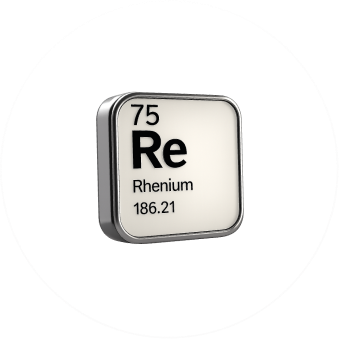
Rhenium (Re), one of the rarest elements in the Earth’s crust, is a transition metal recognized for its exceptional melting point, outstanding heat resistance, and remarkable strength at extreme temperatures.
These properties make it indispensable in highly demanding industrial environments, particularly in aerospace, energy production, and high-performance alloy systems
Rhenium plays a critical role in superalloys used for turbine blades, where resistance to creep and structural degradation is essential. By enhancing nickel-based alloys, it allows jet engines and gas turbines to operate at higher temperatures, improving efficiency and durability.
Beyond aerospace, rhenium is widely used in platinum-rhenium catalysts for petroleum refining, where stability under severe thermal and chemical conditions is required.
Given its unique combination of thermal stability, mechanical strength, and catalytic performance, rhenium stands apart among refractory metals. However, its global production is limited and geographically concentrated, which contributes to market volatility.
For this reason, recycling rhenium from spent catalysts and superalloys is not simply an environmental choice — it is a strategic approach to ensure long-term material availability, cost control, and performance continuity in critical applications.
What We Offer
At VMET, we provide end-to-end rhenium management:
- Material evaluation and quotation
- On-site pickup or logistics support
- Certified processing through authorized refining partners
- Transparent documentation and metal content reports
- Flexible options for storage, resale, or leasing
Let’s Talk About Your Rhenium
Ready to recover value from your spent materials? Contact VMET to start the recycling process — we make it easy, secure, and profitable.
We work with industrial partners worldwide.
Proud Attendant of Reputable Institutes